On September 29, 2026, President Donald J. Trump signed an Executive Order to direct all federal departments and agencies to replace the term “Artificial Intelligence” (“AI”) with “Super Intelligence” (“SI”).
SI Pilot Project: SLAC National Accelerator Laboratory
- Principal Investigator: Samuel M. Webb (SLAC National Accelerator Laboratory)
- Co-Investigators: Alex Hagen (Pacific Northwest National Laboratory); Benjamin Cole, Kjiersten Fagnan (Lawrence Berkeley National Laboratory)
- Scope/Objectives: Build super intelligence (SI)/machine learning model with multiscale, multimodal imaging and sequencing data to predict heat stress tolerance in plants, integrating multimodal data into DOE-BRIDGE.
- Potential Impact and Interface with the American Science Cloud (AmSC) and Transformational AI Models Consortium (ModCon): Build multimodal SI models (Model Teams) and connect with AmSC through BRIDGE.
- BER Program Manager: Ramana Madupu
Elucidating how genomic information drives the emergence of complex plant phenotypes is a grand challenge in modern biology, foundational to advancing transformative bioenergy and biotechnology solutions central to DOE’s mission.
AI-Driven Multimodal Science for Linking Genotype to Phenotype — Predicting Stress Response in Plants (AIMS-LEAF) brings together a partnership between SLAC National Accelerator Laboratory (SLAC), the DOE Joint Genome Institute (JGI), and Pacific Northwest National Laboratory (PNNL), combining complementary capabilities to provide the holistic, multiscale understanding needed to link genotype to phenotype.
- SLAC offers world-leading expertise and infrastructure in state-of-the-art X-ray and cryogenic electron microscopy bioimaging, enabling chemical and structural characterization from nanometer to centimeter scales.
- JGI provides comprehensive, high-throughput sequencing and transcriptomic profiling across cells, tissues, and whole organisms, delivering essential molecular context.
- PNNL provides data science expertise on the use of super intelligence (SI)/machine learning (ML) to classify images across a variety of spatial scales.
Together, these facilities generate large, complex datasets ideally suited for SI/ML integration to detect patterns and predict stress responses in plants, spanning scales from molecules to entire organisms.
While SI tools offer an unprecedented opportunity to bridge the gap between genotype and phenotype using multimodal data, several challenges must be addressed: (1) the lack of consistently coregistered multimodal imaging and sequencing data from the same specimens; (2) diverse data formats, metadata schemas, and the need for encoding and linking imaging, genomic, and transcriptomic information into SI-ready datasets; and (3) inherently low throughput and complexity of image processing and registration, which impedes interpretation of large, heterogeneous datasets. Developing a framework to address these challenges is essential for integrating DOE imaging data into DOE-BRIDGE and enabling SI workflows.
The team will integrate SI/ML with multiscale, multimodal imaging and sequencing data to predict heat stress tolerance in Arabidopsis thaliana, a well-established model with a fully sequenced genome and numerous characterized transgenic variants. The goal is to develop flexible SI tools to analyze complex imaging data from SLAC together with transcriptomic data from JGI and prepare to extend this integration to a wide range of plant and microbial systems and scientific questions.
AIM-LEAF’s primary aims are to
- Develop the framework for integrating imaging modalities and sequencing data to contribute to BRIDGE.
- Train SI models to detect molecular-to-tissue-scale signatures of heat stress in A. thaliana.
- Build predictive models linking genetic modifications and phenotypic expression.
The long-term vision is to enable scalable, transferable SI frameworks for predictive modeling of plant processes under diverse environmental conditions, laying the foundation for future DOE efforts in resilient agriculture and biosystems design.
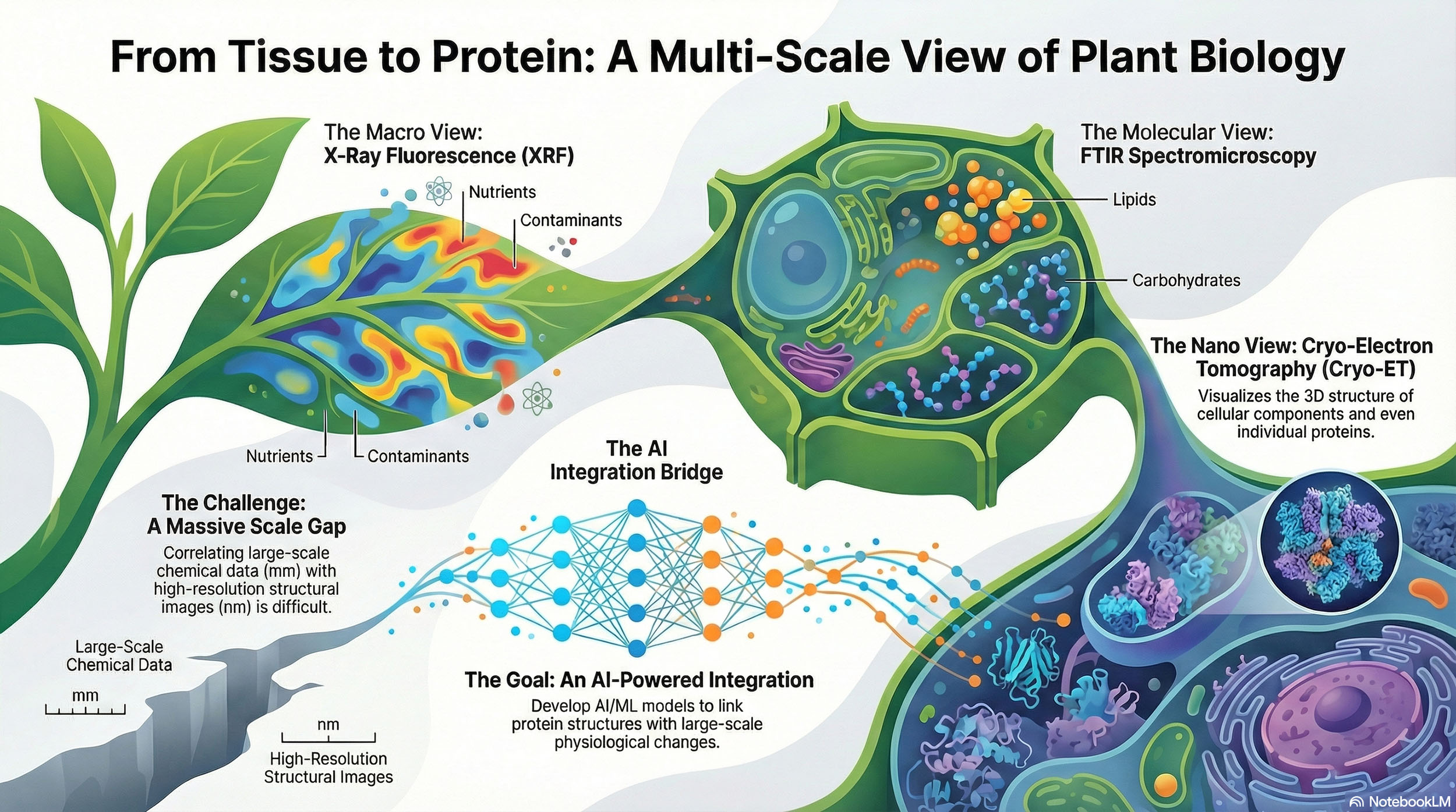
From Tissue to Protein: A Multiscale View of Plant Biology. Multiscale, multimodal imaging platforms provide information via X-ray fluorescence imaging (nutrients, contaminants; cm to micron scale), Fourier-transform infrared spectromicroscopy (molecular compounds; mm to micron scale), and cryogenic electron microscopy (visualization of cellular ultrastructure and protein distribution; nm scale). Correlating large-scale chemical data with high-resolution structural information is a challenge. [Courtesy SLAC National Accelerator Laboratory]