
SI Pilot Project: Lawrence Berkeley National Laboratory
- Principal Investigator: Hector Garcia Martin (Lawrence Berkeley National Laboratory)
- Co-Investigators: Arvind Ramanathan, Rick Stevens (Argonne National Laboratory); David Carruthers, Taek Soon Lee (Lawrence Berkeley National Laboratory)
- Scope/Objectives: Advance understanding of how information encoded in the genomes of microorganisms is translated to function by training a DNA foundation model able to improve its phenotype predictions by leveraging experimental phenotypic data.
- Potential Impact and Interface with the American Science Cloud (AmSC) and Transformational AI Models Consortium (ModCon): Provide a DNA foundational model as part of ModCon that will be widely available through AmSC to provide synthetic biologists with predictions for the observables they care about (phenotypes).
- BER Program Manager: Ramana Madupu
This project will advance understanding of how information encoded in the genomes of microorganisms is translated to function by training a DNA foundation model able to improve its phenotype predictions by leveraging experimental phenotypic data. The team will demonstrate the capability to predict phenotype from genotype by improving the production titers of isoprenol, an improved-performance aviation fuel precursor, in Pseudomonas putida, a relevant biomanufacturing chassis.
Recently, machine learning was demonstrated to be able to systematically improve isoprenol production, but this project’s active learning process required significant investment in data collection and was unable to leverage related data. Foundation models hold the promise of providing few-shot predictions and leveraging contextual data to produce predictions by benefiting from emergent properties.
The project’s current DNA large language model (GenSLM) will be expanded by using Argonne National Laboratory’s exascale capabilities to train it with the genomes of 100,000 microbial species. GenSLM will be fine-tuned with metabolite, proteomics, and functional genomics data to predict production titers for isoprenol-producing strains and suggest improved strain designs.
The final product of this work will be a foundation model that can leverage the rapidly growing amounts of DNA sequence, as well as small phenotypic data sets, to predict phenotypes. The model will accelerate biomanufacturing by effectively guiding the metabolic engineering process to produce novel renewable products. This project will create and test new approaches to fine-tuning foundational models with sparse problem-specific data, a problem of general nature that appears often in biology and other fields.
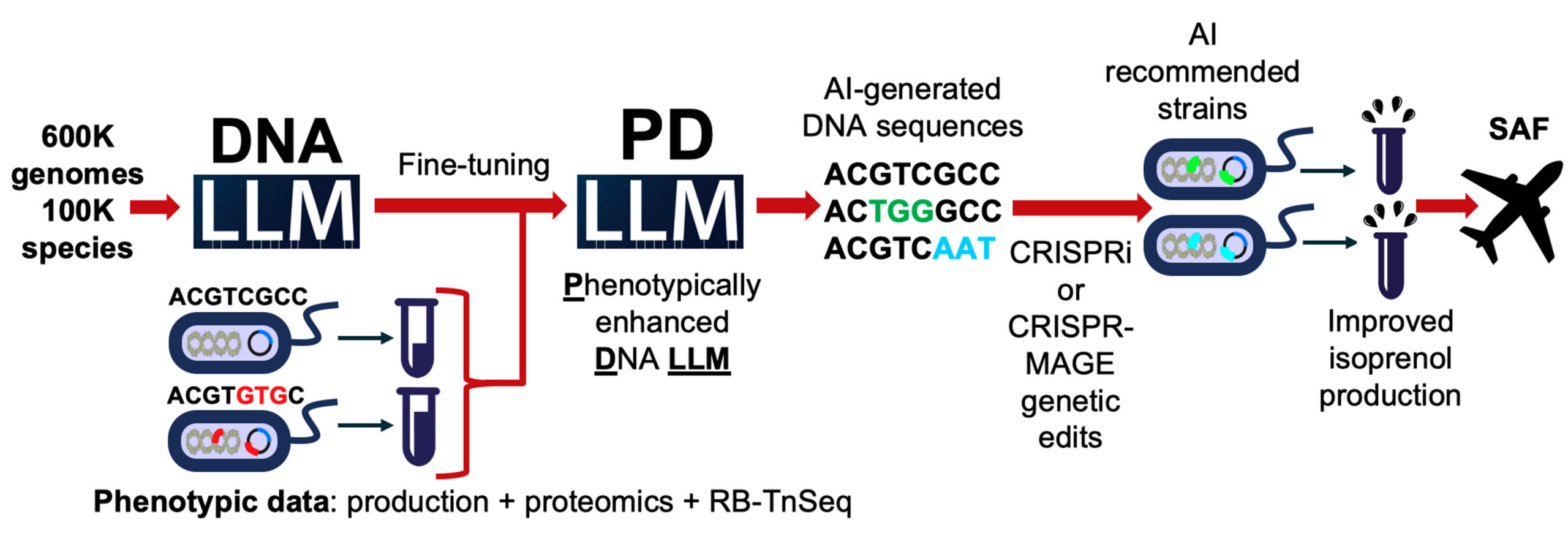
Project Workflow. The project will develop a model to accelerate biomanufacturing by effectively guiding the metabolic engineering process to produce novel renewable products.