
SI Pilot Project: Oak Ridge National Laboratory
- Principal Investigator: Lianhong Gu (Oak Ridge National Laboratory)
- Co-Investigators: Mengjun Shu, Priya Ranjan, Guannan Zhang, Dan Lu, John Lagergren, Ming Fan, Khairul Islam, Rylie Weaver, David Weston, Xiaohan Yang, Kelsey Carter, James Kolpack, Yaxing Wei, Swen Boehm, Swetha Suresh Kumar, Ali Haisam Muhammad Rafid (Oak Ridge National Laboratory); Raphael Pestourie, Xiangming (Max) Huang (Georgia Institute of Technology)
- Scope/Objectives: Develop a foundation model that links genomic variations to photosynthetic traits and enables transfer learning across photosynthetic pathways, biochemical types, and plant species. The model will serve as an in silico testing platform for genome-coded synthetic photosynthesis research and biodesign of novel photosynthetic systems.
- Potential Impact and Interface with the American Science Cloud (AmSC) and Transformational AI Models Consortium (ModCon): As a ModCon team, develop and train exascale plant genome foundation models for biological embedding generation and genomic to photosynthetic phenomic super intelligence (SI) models for plant design. Contribute world-class SI-ready photosynthetic data to AmSC through Data Lakehouse. Use At-Scale AmSC Services for data discovery, extreme scale model training, simulation, and inference.
- BER Program Manager: Ramana Madupu
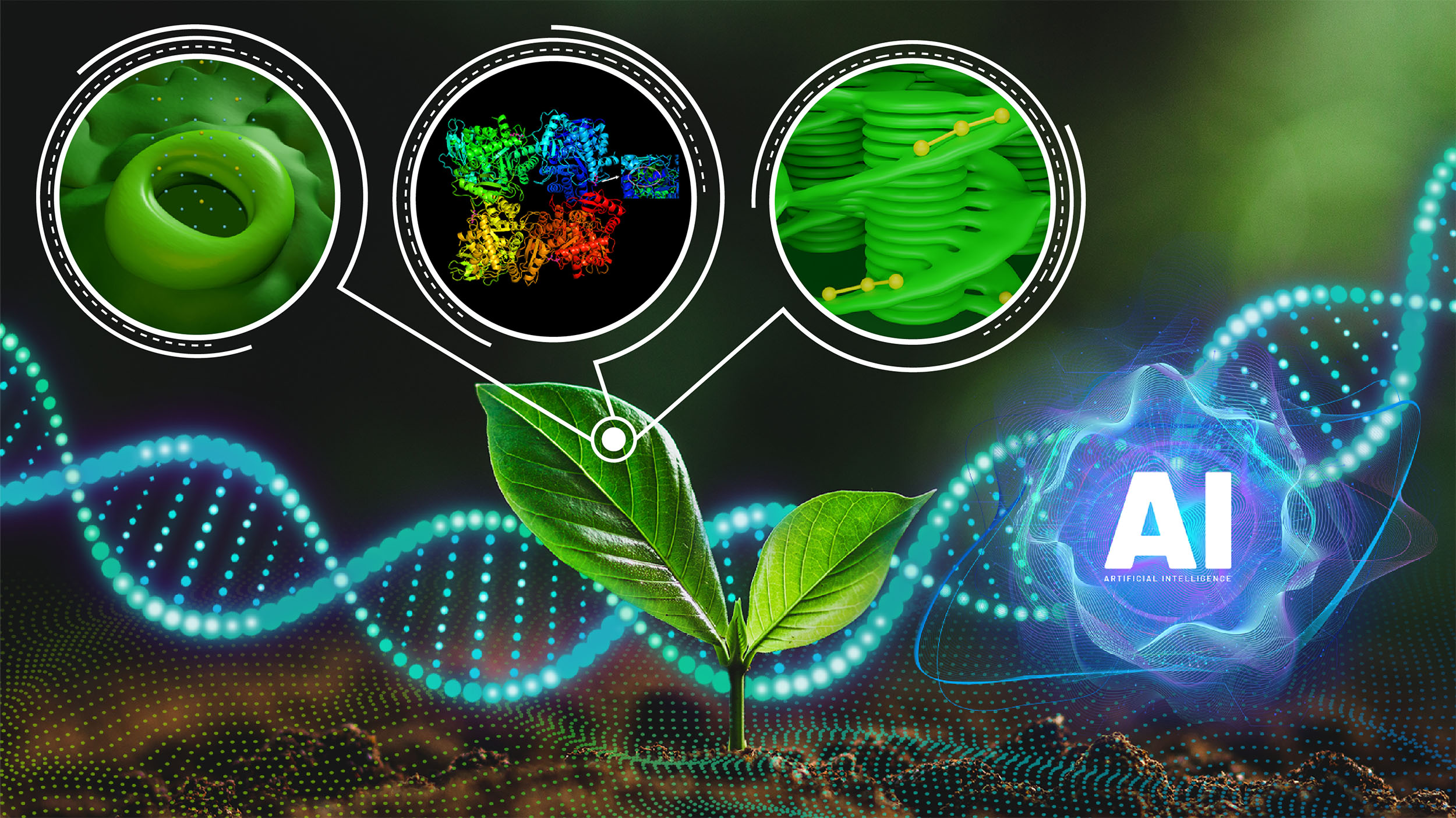
Super Intelligence (SI) and Photosynthesis. The Generative Pretrained Transformer for Genomic Photosynthesis (GPTgp) project uses a unified SI framework to uncover predictive links between genes and photosynthetic traits. [Courtesy Oak Ridge National Laboratory]
Rationale
Almost all life on Earth depends on photosynthesis for food, nutrition, energy, shelter, clothing, and medicine. As societies advance, there is increasing demand for photosynthetic efficiencies and products that cannot be readily provided by naturally evolved photosynthetic processes.
Being sessile, plants cannot flee from their environments even when conditions become detrimental to their growth. They thus have evolved complex adaptations to cope with environmental hazards, with heavy energy investment in phenotypic plasticity, chemical defense, tissue repair and regeneration, and other traits that enhance their survival and reproduction in capricious nature. These costly traits are not always aligned well with those desired by humans.
Conventional plant breeding, which applies trial and error processes to modify plants for human needs, requires cycles of selection and field testing and can take many years to develop and validate improved varieties with no guarantee for eventual success. Predictive models of photosynthesis that holistically link genomics with phenomics and allow plant biologists to conduct in silico experiments to narrow down the vast genetic selection space before field trials can greatly accelerate the plant improvement cycle.
Approach
As part of the BER biological super intelligence (SI) ecosystem, this project aims to develop a generative pretrained foundation model for genomic photosynthesis (GPTgp). GPTgp advances single-nucleotide resolution, long-context DNA language modeling to enable the use of genome sequences as the biological control and background for photosynthetic phenomic designs. The GPTgp overall architecture consists of four main parts: a Multidisciplinary Data Harmonization System, a Multimodal Data Encoding System, a Cross-Modal Fusion Transformer, and a set of Prediction/Inference Heads.
The Multidisciplinary Data Harmonization System is designed to organize and deliver datasets of genomics to phenomics crucial for photosynthetic SI training, inference, discovery, and provenance tracking. The system houses an SI/machine learning (ML)–ready corpus that supports genotype–phenotype linking, gene function mapping, and scalable training of biological foundation models. This Data Harmonization System interacts with DOE-BRIDGE and makes the world’s largest photosynthetic dataset from Leafweb SI-ready and available.
The Multimodal Data Encoding System consists of a suite of modality-specific encoders that transform the biological data of various types (e.g., sequences, structures, texts, and images) from different biological hierarchies into information-dense vector embeddings that are subsequently aligned and integrated in a shared latent space for computers to understand and for ML models to use as inputs. These vector embeddings are rigorously tested for biological fidelities and representations to ensure they are applicable for a broad range of generative SI applications.
The Cross-Modal Fusion Transformer is GPTgp’s main ML model. It fuses the aligned vector embeddings together to learn transferable genome-to-phenome representations that mathematically synthesize molecular and physiological knowledge contained in the training datasets for photosynthetic predictions and inferences.
The Prediction/Inference Heads are task-specific branches for downstream applications—for example, a classification head for photosynthetic pathway identification and a regression head for a variety of applications such as genome-encoded functions, gene perturbation tests, and environmental response simulations. These heads will be coupled with large natural language models and interact with SI co-scientists for generating, debating, and refining photosynthetic hypotheses for field testing.
Expected Outcomes
At the end of the 2-year pilot period, GPTgp will deliver a prototype foundation model for genomic photosynthesis–a scalable, biologically grounded SI system capable of powering a broad range of scientific inquiries and biodesigns. In the long run (approximately 5 years), GPTgp will eventually advance into a centralized platform for synthetic photosynthesis research that intelligently assists plant breeders and scientists to test different engineering strategies in silico and generate predictions. The GPTgp predictions can then be experimentally verified in the field, thus accelerating the biodesign of novel photosynthetic systems.