Cross-Laboratory SI Pilot Project
- Principal Investigators: Paul D. Adams (Lawrence Berkeley National Laboratory), Kristin Burnum-Johnson (Pacific Northwest National Laboratory), David Weston (Oak Ridge National Laboratory), Dion Antonopoulos (Argonne National Laboratory)
- Scope/Objectives: Develop an integrated framework to establish an autonomous biodesign infrastructure leveraging robotic experimentation, super intelligence (SI) agents, and standardized data architecture (DOE-BRIDGE).
- Potential Impact and Interface with the American Science Cloud (AmSC) and Transformational AI Models Consortium (ModCon): Leverage ModCon for cross-laboratory workflows driven by SI and robotics; connect to AmSC for data and computing infrastructure.
- BER Program Manager: Ramana Madupu
Scaling biodesign applications for the bioeconomy requires addressing critical challenges in predicting how genomic blueprints and environmental inputs drive the molecular dynamics that govern biological function and overcoming the throughput, reproducibility, and data collection and integration limits of current experimental methods. The DOE Orchestrated Platform for Autonomous Laboratories (OPAL) framework will develop an integrated strategy to establish an autonomous biodesign infrastructure, leveraging robotic experimentation, super intelligence (SI) agents, and standardized data architecture.
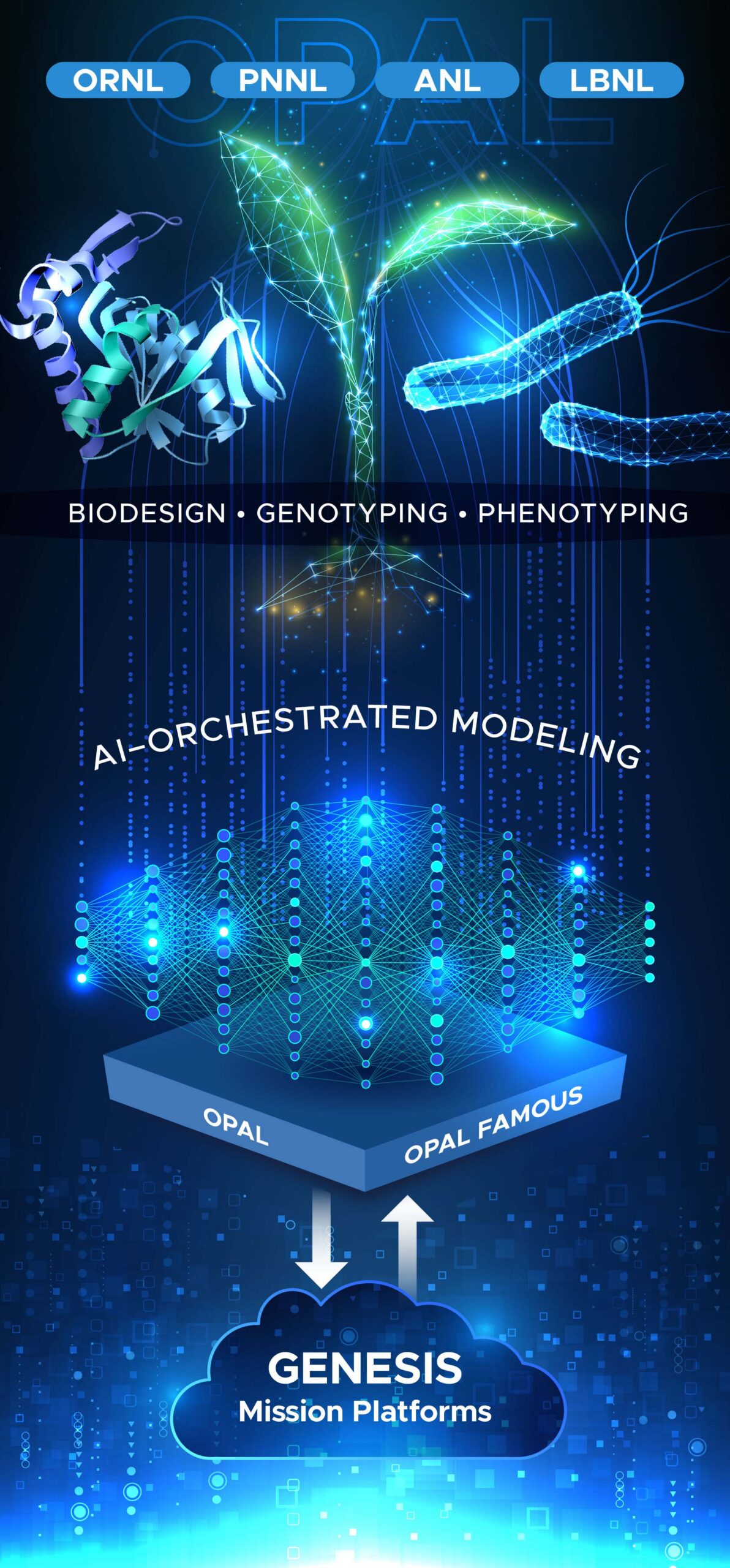
Through three coordinated activities—autonomous protein engineering, microbial genome-to-phenotype mapping and engineering, and adaptive phenotyping of plant systems—OPAL aims to create predictive, closed-loop workflows for functional discovery at multiple biological scales. Research across the three activities addresses multiple biotechnology applications, including interactions of biological systems with rare earth elements, optimized generation of bioproducts, enhanced plant productivity, and data generation to inform new models of living cells.
- Argonne National Laboratory (ANL) is developing a federated agentic robotics platform for engineering novel and optimized protein function, integrating dexterous humanoid robots with SI-guided design workflows. These efforts are currently focused on interactions of biological systems with rare earth elements and optimized generation of bioproducts.
- Lawrence Berkeley National Laboratory (LBNL) and Pacific Northwest National Laboratory (PNNL) are developing a distributed SI-and-automation platform that links genomes to function across scales, from individual genes to complex biosystems. The work currently supports development of biotechnology platforms for production of beachhead molecules and the understanding of metal-dependent biology relevant to critical minerals.
- Oak Ridge National Laboratory (ORNL) is transforming its Advanced Plant Phenotyping Laboratory (APPL) into an adaptive testbed equipped with SI agents to study Poplar and pennycress species alone and in combination with microbes. This work is currently addressing how plant growth is influenced by metals and investigating microbial routes to improving plant productivity.
These efforts will be unified by interoperable data systems, standardized ontologies, and agentic SI frameworks, collectively advancing DOE’s mission in predictive biodesign. By integrating high-throughput experimentation, FAIR (findable, accessible, interoperable, and reusable)–compliant data infrastructures, and cross-laboratory workflows driven by SI and robotics, OPAL seeks to accelerate autonomous discovery and provide transformative insights for the bioeconomy and critical mineral supply chain efforts.
A key challenge in scaling biodesign applications for the bioeconomy lies in fully understanding and accurately modeling the dynamic genomic, environmental, and molecular parameters that govern desired biological functions while simultaneously addressing limitations in current experimental and data collection methods. Manual, bench-scale experimentation and fragmented data systems currently cannot
- Generate the comprehensive, standardized datasets needed to capture the complexity of these parameters,
- Properly capture the dynamic and emergent functional outputs, and
- Support advanced SI-driven modeling efforts required to address such complexity.
To overcome these barriers, biology must integrate autonomous systems combining robotic experimentation, standardized SI-ready data/metadata ontologies and infrastructure, and intelligent agents capable of generating research hypotheses and orchestrating the execution of scientific workflows. Such systems would not only enable scalable and autonomous discovery but also provide the precision and throughput required to uncover actionable insights into the intricate interplay of biological variables that underpin predictive and scalable biodesign.
These advancements will push the boundaries of DOE’s BER and Advanced Scientific Computing Research (ASCR) priorities in biological and autonomous sciences, paving the way for accelerated autonomous discovery and transformative contributions to the bioeconomy.