SI Pilot Project: Lawrence Berkeley National Laboratory
- Principal Investigator: Paul D. Adams (Lawrence Berkeley National Laboratory)
- Co-Investigators: Dion Antonopoulos (Argonne National Laboratory), Qun Liu (Brookhaven National Laboratory), Jon Taylor (Oak Ridge National Laboratory), James Evans (Pacific Northwest National Laboratory), Aina Cohen (SLAC National Accelerator Laboratory)
- Scope/Objectives: Initiate a connected data and workflow framework that can be used by all BER-supported photon, neutron, and imaging resources enabling biological discovery and biomolecular design.
- Potential Impact and Interface with the American Science Cloud (AmSC) and Transformational AI Models Consortium (ModCon): Leverage AmSC infrastructure for compute, data, and agentic super intelligence.
- BER Program Manager: Resham Kulkarni
BER supports world-class photon, neutron, and electron facilities that generate complementary structural biology and imaging data critical for understanding complex biomolecular systems. However, these datasets are currently fragmented across facilities—stored in disparate formats and silos—making it difficult to integrate multimodal data for advanced analyses. This lack of interoperability limits progress on grand-challenge science that requires combining crystallography, scattering, cryogenic electron microscopy/tomography, nuclear magnetic resonance, and imaging data into unified views of biological structure and function.
LAMBDA: A Lakehouse-enabled AI-ready Multi-modal Bioimaging Data Architecture, a cross-facility, standardized data framework for all BER-supported structural biology and imaging resources, aims to address this lack of interoperability. LAMBDA is establishing common data structures, metadata standards, and application programming interfaces (APIs) to enable seamless integration of multimodal datasets into DOE-BRIDGE while incorporating super intelligence (SI) tools for automated data access, harmonization, and workflow execution.
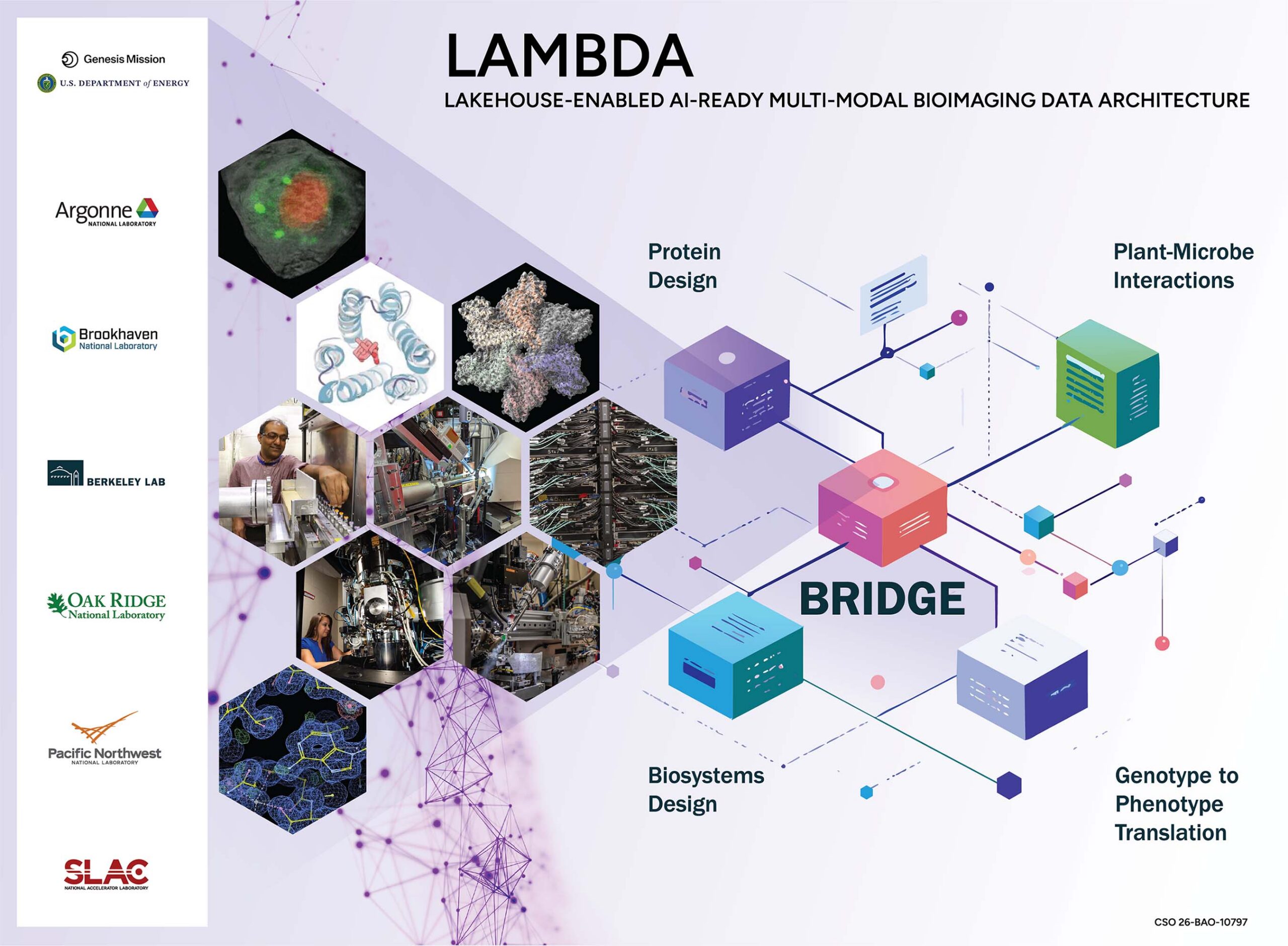
LAMBDA follows a modular architecture, supporting raw data ingestion, structured metadata for integrative querying, and SI-ready processed datasets for SI-powered downstream workflows. Wherever possible, researchers leverage existing community standards (e.g., Protein Data Bank, NeXus, macromolecular crystallographic information file, Electron Microscopy Public Image Archive, Simple Scattering) and DOE data infrastructure (e.g., BRIDGE, DOE Systems Biology Knowledgebase, DataFed) to ensure interoperability and sustainability. The approach is organized into three activities:
- Community Input: Convening workshops and working groups to assess current practices, identify challenges in developing SI-ready data and federated workflows, and select high-value BER science use cases to drive framework development.
- Standardization: Developing a shared, API-accessible data and metadata infrastructure aligned with community schemas and BRIDGE design patterns, enabling cross-facility discovery and SI integration.
- Workflows: Implementing automated, facility-adaptable workflows for metadata capture, harmonization, quality control, and secure data deposition, ensuring local practices are respected while enabling global interoperability.
In addition, selected science use cases will demonstrate the framework’s value across BER research, potentially including critical mineral recovery, host–environment interactions, or biofuel and bioproduct production.
By unifying structural biology and imaging data across photon, neutron, and electron sources, LAMBDA will transform how BER researchers discover, integrate, and analyze multimodal datasets. This will accelerate SI-driven investigation into genotype–phenotype relationships, biomolecular design principles, and biological responses to environmental change, enabling predictive modeling and biotechnology innovation.