
SI Pilot Project: Argonne National Laboratory
- Principal Investigator: Christopher Henry (Argonne National Laboratory; ANL)
- Co-Investigators: Arvind Ramanathan (ANL), Ellen Neidle (University of Georgia), Nidhi Gupta (ANL), Nick Chia (ANL), Gyorgy Babnigg (ANL), Paul Abraham (Oak Ridge National Laboratory), Yasuo Yoshikuni (Lawrence Berkeley National Laboratory; LBNL), Adam Arkin (LBNL)
- Scope/Objectives: Merge generative super intelligence (SI), SI agents, and mechanistic modeling with automated adaptive laboratory evolution in a self-improving loop, where agents plan the experiments whose measurements retrain both the generative models that propose enzyme sequences and the mechanistic models that guide strain design.
- Potential Impact and Interface with the American Science Cloud (AmSC) and Transformational AI Models Consortium (ModCon): Contribute to ModCon the GenSLM-ESM foundation model, the StructBioReasoner agentic design framework, the mechanistic modeling frameworks that guide strain design, and the activity classifiers trained on AI-ALE measurements. Deliver quantitative activity data for thousands of enzyme and strain variants, with matched multiomics readouts, to AmSC through KBase/DOE-BRIDGE. Draw on AmSC for exascale training and agentic design.
- BER Program Manager: Ramana Madupu
AI-ALE, the Combined Multimodal AI and Adaptive Lab Evolution (ALE) for the Rapid Scale-Up of Generalized Protein and Pathway Design project, is developing generative super intelligence (SI) tools such as the GenSLM-ESM model, which can propose millions of plausible enzyme sequences to support enzyme design. StructBioReasoner, AI-ALE’s agentic design framework, extends these models by running thousands of reasoning agents in parallel on Argonne National Laboratory’s (ANL) Aurora exascale system to propose and evaluate candidate variants in silico. Yet, these tools still cannot reliably determine which proposed sequences will perform well in vivo.
AI-ALE is filling this gap by integrating three technologies: (1) automated ALE with the ability to scan a vast solution space of potential variants to identify the best performers; (2) DNA synthesis and Golden Gate Assembly to synthesize large combinatorial libraries of variant genes cost efficiently; and (3) automated genetic transformation of a naturally competent bacterium, Acinetobacter baylyi ADP1, to enable growth-based selection of the best performing enzymes. By combining these methods with SI agents capable of conducting sophisticated experimental design, researchers can apply SI foundational models to design ideal DNA sequence libraries for the efficient sampling of variant space for a protein family of interest.
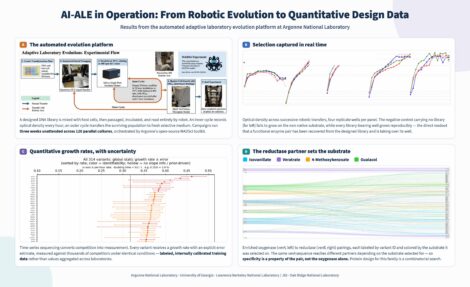
AI-ALE in Operation. (A) The automated evolution platform: a designed DNA library is mixed with host cells, then passaged, incubated, and read entirely by robot, running 3 weeks unattended across 120 parallel cultures. (B) Optical density across successive robotic transfers; the control carrying no library fails to grow on the non-native substrate while every library-bearing population grows. (C) Time-series sequencing converts competition into measurement, giving each variant a growth rate with an explicit error estimate. (D) Enriched oxygenase-to-reductase pairings colored by substrate; the same verA sequence reaches different partners depending on the substrate, so specificity is a property of the pair.
Libraries are synthesized with additional combinatorial variation provided by Golden Gate Assembly and then are automatically introduced into A. baylyi by mixing cells and DNA in the wells of a microtiter plate. Allelic replacement integrates the synthesized DNA into the chromosome of the recipient strain, thereby generating a bacterial population with individual cells expressing protein variants. With the selective conditions used in the automated robotic ALE platform, faster growth corresponds to enzymes that have improved catalytic activity using desired substrates. The high-throughput competition of cells expressing different enzyme variants in the automated ALE cultures results in rapid evolutionary trajectories that are revealed by DNA sequencing.
In this fashion, researchers can quantify the relative performance of every enzyme variant successfully introduced into each cell population. The result is the quantitatively measured performance of thousands of competing enzyme variants across multiple conditions, all from a single automated, robotic experiment. The data generated are sufficient to train machine learning models that predict how in vivo enzyme performance varies with sequence, supporting rational targeted redesign of new enzymes operating against a variety of chemical substrates.
AI-ALE demonstrates this platform with two kinds of enzymes: one required for biodegradation and the other for biosynthesis. The former target is a large family of two-component Rieske non-heme iron monooxygenases that catalyze aryl O-demethylation, a critical type of reaction acting on lignin-derived methoxylated aromatic compounds. Such enzymes are biocatalysts with applications in lignin valorization and biomanufacturing. Although enzymes in this family act on diverse substrates, we use the designation VerAB to refer collectively to the two components of the diverse family variants. A library of 35,422 VerAB genes was used to transform A. baylyi in the automated ALE platform. Mutants were selected that acquired the ability to use four different non-native growth substrates, each as a sole carbon source: veratrate, isovanillate, guaiacol, and 4-methoxybenzoate. None of these compounds can support growth of the wild type even with prolonged selection for spontaneous mutations. In a single experiment, researchers quantified the performance of thousands of VerAB variants on each substrate, producing sufficient data to support rational engineering of VerAB activity against a range of substrates.
The second enzymatic target is an aldolase that is not native to A. baylyi. By altering the substrate specificity of this enzyme, designated DgoA, the shikimate pathway for aromatic compound biosynthesis was significantly altered. Metabolic engineering of this pathway has important applications in biomanufacturing to produce aromatic bioproducts and related compounds. In this example, researchers screened mutated dgoA libraries as well as mutations that enable prototrophic growth of a strain with a deficient DgoA enzyme. AI-ALE’s mechanistic modeling pipeline used proteomics data from these experiments to determine how strain mutations rerouted flux to increase reactant pool sizes for the DgoA enzyme.
This project is supported by ANL’s open-source MADSci toolkit, which orchestrates the instruments and workflows of the automated laboratory, together with an SI-integrated laboratory information management system that unifies robotics, short- and long-read sequencing, proteomics, metabolomics, and transcriptomics data from four institutions into a single queryable resource that is wired directly into the analysis code and, through KBase and BRIDGE, into the broader BER data ecosystem.