
SI Pilot Project: Argonne National Laboratory
- Principal Investigators: Arvind Ramanathan (Argonne National Laboratory), Josh Michener (Oak Ridge National Laboratory)
- Co-Investigators: Debsindhu Bhowmik, Serena Chen, Omar Demerdash, John Lagergren (Oak Ridge National Laboratory); Nicholas Chia, Janaka Edirisinghe, Jose P. Faria, Christopher Henry, Xinran Lian, Sam Seaver, Ray Zhu (Argonne National Laboratory)
- Scope/Objectives: Create a scalable, autonomous agentic system, which will be a foundational driver for development of DOE-BRIDGE.
- Potential Impact and Interface with the American Science Cloud (AmSC) and Transformational AI Models Consortium (ModCon): Leverage AmSC in congruence with BRIDGE and open domain-specific and natural language models to autonomously guide enzyme discovery and design approaches.
- BER Program Manager: Ramana Madupu
The Intelligent Design Assistant (IDeA) project addresses critical bottlenecks in biosystems design by developing the first intelligent computational assistant [a super intelligence (SI) co-scientist] that autonomously guides enzyme discovery and biosynthetic pathway optimization within the BER ecosystem.
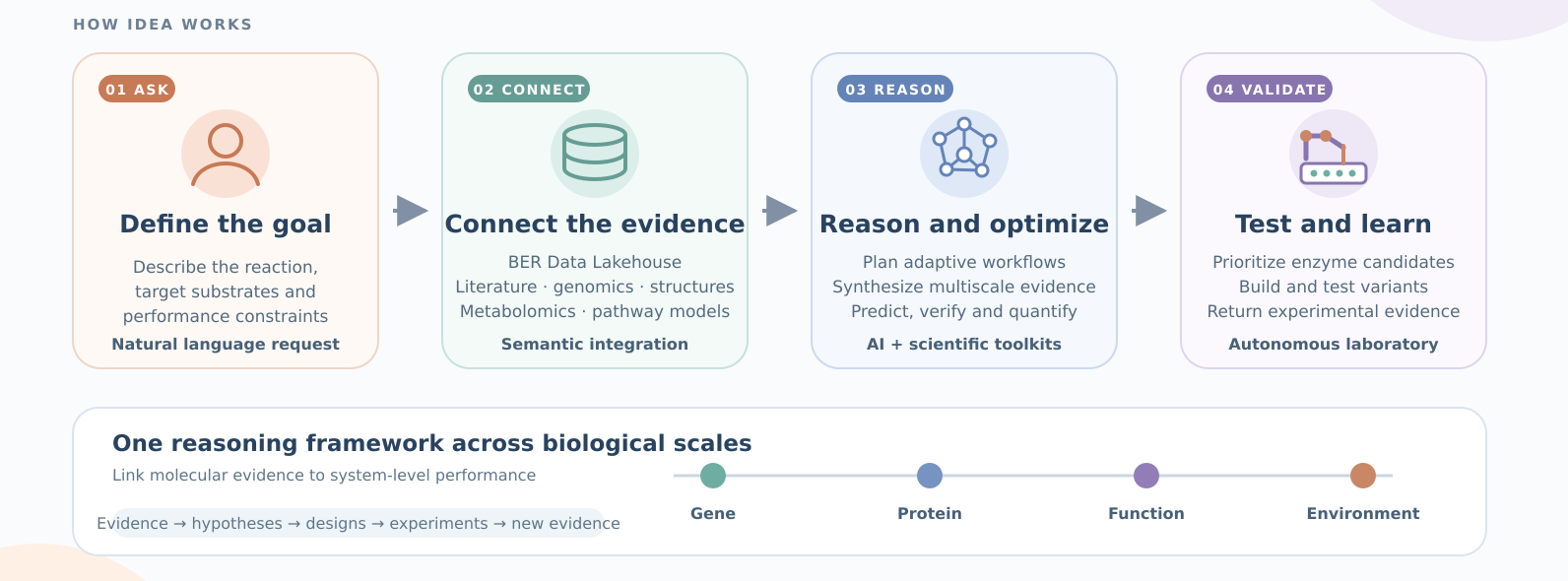
Current biosystems design processes are severely constrained by time-intensive, expert-dependent approaches requiring years to transition from concept to scalable production, while fragmentation of biological data across siloed databases prevents SI from realizing its transformative potential. IDeA addresses these challenges by creating a scalable, autonomous computational framework (agentic framework) that serves dual purposes as both a transformative scientific tool and foundational driver for development of DOE-BRIDGE.
The pilot phase focuses on three integrated aims to establish IDeA’s foundational capabilities using amide synthetases for polyamide biosynthesis as a motivating use case.
- Aim 1 develops an SI co-scientist that intelligently orchestrates computational biology toolkits through enhanced natural language interfaces, comprehensive tool integration (e.g., bioinformatics, cheminformatics, simulation), and step-by-step computational decision-making processes with built-in verification mechanisms.
- Aim 2 implements reasoning frameworks through computational models integrating diverse data across gene, protein, function, and environment scales and causal reasoning modules to enable interpretable, mechanistically informed discoveries.
- Aim 3 establishes multi-objective optimization frameworks that simultaneously improve enzyme kinetic parameters, thermostability, and substrate selectivity while incorporating Bayesian uncertainty quantification to guide experimental validation.
The 2-year pilot will deliver quantifiable scientific advances including (1) discovery of three to five novel amide synthetase candidates with more than ten times acceleration in enzyme characterization compared to manual approaches, (2) demonstration of greater than 80% accuracy in enzyme function prediction/annotation, and (3) validation of three to five optimized enzyme variants showing measurable improvements in at least two target properties. IDeA will leverage support from other DOE, BER, and (National) Laboratory-directed research and development (LDRD) programs.
IDeA will contribute foundational BRIDGE infrastructure modules including semantic interoperability frameworks, automated literature integration pipelines, and community-accessible optimization algorithms specifically designed for biological systems constraints. The project also brings together an interdisciplinary team of researchers encompassing computational biology, genome science, mathematical sciences, and SI/machine learning across two National Laboratories (Argonne National Laboratory and Oak Ridge National Laboratory) to address enzyme discovery, design, and optimization as a prototype application for SI-based advanced reasoning techniques.
IDeA thus represents the first truly autonomous agentic system capable of functioning as an SI co-scientist within the biological sciences, leveraging DOE’s exascale computing infrastructure to orchestrate complex workflows spanning discovery, annotation, characterization, and design using federated data lakehouse architecture.
The system transforms biosystems design from trial-and-error to data-driven and hypothesis-informed process, reducing development timelines from years to months while dramatically improving success rates. By integrating supercomputing capabilities with federated biological data access, IDeA enables simultaneous optimization of millions of enzyme variants and thousands of pathway configurations, delivering data-driven design decisions that account for molecular interactions, environmental conditions, and industrial constraints beyond human expert capabilities. This foundational agentic infrastructure serves as a generalizable platform for diverse DOE applications, representing a critical investment in the computational biology capabilities required to maintain American technological leadership in biotechnology.